
Everything your in-house recon should be, already built
Most in-house builds match the payments you expected and stop there. End Close is a complete product your finance team runs every day, with managed pipelines, rules they can change and an audit trail.

- Of transactions matched automatically
- 99.999%
- To go live, with our team on the integration
- 2–6 weeks
- Typical in-house build before the first live recon
- 6–18 months
- With pipelines built and run by us
- Managed solution
Internal tooling vs a product finance relies on
An in-house build answers one question: did the payments we expected arrive? End Close answers that too, then handles the returns, reversals, format changes and exceptions that follow.

End Close
Transaction-level reconciliation that runs daily, across every system money moves through.
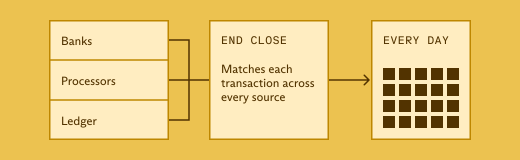
Best for teams that
- Want finance to own reconciliation day to day
- Want engineers back on the product roadmap
- Add banks, processors and rails as they grow
- Need an audit trail their auditors will accept
- Want an independent check on their own ledger

In-house build
Matching scripts and rules your engineers write and maintain, usually next to your ledger.
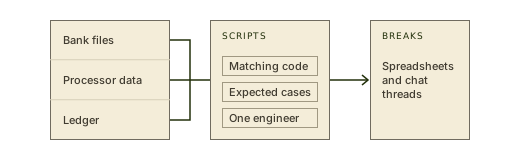
Best for teams that
- Have a team that will own recon for years
- Reconcile one bank and one processor
- Rarely see returns or reversals
- Prefer every rule to live in their own codebase
- Have engineers free to add new banks and processors

Why payments teams choose End Close over building in-house

Maintained for you

Built for the edge cases

Run by finance, not engineering


 vs.Building in-house
- Transaction matchingMatching transactions across banks, processors and your ledger.
- End CloseYes, 99.999% automated
- Building in-houseYes, for the cases you build
- Data pipelinesBank and processor files, reports and APIs, kept running.
- End CloseManaged by End Close
- Building in-houseBuilt and fixed by your engineers
- Returns, reversals and disputesPayments that change state weeks after they settle.
- End CloseYes, built in
- Building in-houseOften left for a later version
- Exception workflowAn owner, an investigation and a resolution for every break.
- End CloseYes, with AI investigation
- Building in-houseUsually spreadsheets and chat
- Time to go liveFrom kickoff to first live reconciliation.
- End Close2–6 weeks
- Building in-house6–18 months
- Audit trailWho matched, adjusted or wrote off what, and why.
- End CloseYes, every action logged
- Building in-houseOnly what you build and keep
- Rule changesUpdating matching logic when a bank or processor changes.
- End CloseAgents propose and back-test them
- Building in-houseAn engineering ticket


See End Close on your own transaction data.
Where payments teams outgrow in-house recon
An in-house build works while volume is low and your banks and processors stay the same. As you grow, four limits tend to show up.

Engineers move on

Edge cases pile up
One person understands it

No independent check
Questions about replacing an in-house build
Does End Close work with the ledger we built?
Why not build it ourselves with AI?
Do we lose control of our matching logic?
What happens to the reconciliation we run today?
Will our auditors accept End Close?

Retire your in-house recon without a rewrite
- 01
Six months reconciled, free
Send us your history and we walk you through every exception it finds. - 02
We run the integration
Pipelines, rules and history set up by our team, not your engineers. - 03
Parallel run
Keep your current system live until the numbers tie out.
Bring up to six months of history. We reconcile it for free, then run alongside your current system until the numbers tie out.